Kitchen styling advice online has a problem. Every mood board, every Pinterest grid, every magazine spread shows a kitchen that has been emptied of the things that make kitchens actual kitchens. No washing-up liquid bottle. No mug tree inherited from someone’s grandmother. No stack of takeaway menus shoved between the toaster and the wall.
Real British kitchens are working rooms. And styling them has to start from that reality — most people never quite figure out how to make a working kitchen feel styled rather than just furnished. That gap between “it works” and “I love it” is exactly what this list addresses.
I’ve styled three different kitchens in British homes — one rented Victorian terrace, one first-buyer new build, and the one I’m in now. Here’s what actually moves the needle.
TL;DR: The 12 ideas below are ranked loosely by impact-to-effort ratio. You won’t need all of them. Start with ideas 1, 2, and 5 — they cover lighting, textiles, and herbs, and together they cost under £50. That combination alone will make your kitchen feel intentionally designed rather than accidentally assembled.
Read more: home interior ideas overview
1. Why Add Under-Cabinet LED Strip Lighting?
Under-cabinet lighting is the single highest-impact kitchen upgrade that doesn’t require a builder. A strip of warm-white LEDs underneath your wall cabinets floods the worktop with functional task light and adds the layered, considered feel that overhead lighting alone can’t achieve.
The key is colour temperature. Choose 2700K warm white, not 4000K or “daylight.” Daylight LEDs make a kitchen look like a supermarket; warm white makes it look like a home. B&Q’s Diall LED strip light starts at ~£18 for a 1-metre self-adhesive strip with a plug-in connector — no electrician required.
I fitted under-cabinet strips in my current kitchen on a Saturday afternoon. The difference was so pronounced that my partner, who had previously resisted the idea, asked if we could add them over the hob too. Total cost: £36. Total time: 90 minutes. It’s the best value kitchen upgrade I’ve ever made.
2. How Do You Coordinate Your Kitchen Textiles?
This is the cheapest and most underrated kitchen styling idea. A matching set of tea towels, a coordinating oven glove, and a washing-up brush in a consistent colour family transform a kitchen from cluttered to curated without changing a single fixture. Mismatched textiles make even a beautiful kitchen look chaotic; a matched set makes even an ordinary kitchen feel considered.
Pick one colour to coordinate around — sage green, navy, terracotta, or classic stripe are the most popular in British kitchens. Then buy a set of three matching tea towels (~£8–£12 from Dunelm or H&M Home) and replace any visually jarring accessories — that fluorescent washing-up brush, the plastic-handled oven glove — with ones in your chosen colour.
3. Create a Windowsill Herb Display
A row of three ceramic herb pots on the kitchen windowsill serves two purposes at once: it looks intentional and styled, and it actually provides fresh herbs for cooking. This is the only kitchen decor idea where the decor genuinely earns its place. The display works best with an odd number of pots — three is ideal — all in the same style and colour.
IKEA’s Plastis pot in white is the most popular choice for good reason: it’s clean, inexpensive (~£1.50 each), and works in every kitchen. For something more textured, Dunelm sells ribbed ceramic herb pots in sets of three from ~£12. Plant with rosemary, basil, and thyme — the three herbs that look good at the window, tolerate kitchen conditions, and get used often enough to stay healthy.
The herb display signals something about the kitchen that no other single element does: it says the person who cooks here cares about what they eat. That’s a form of personality. Most kitchen decor is neutral and aspirational; a genuine herb display is specific and personal.
4. Why Decant Dry Goods Into Glass Storage Jars?
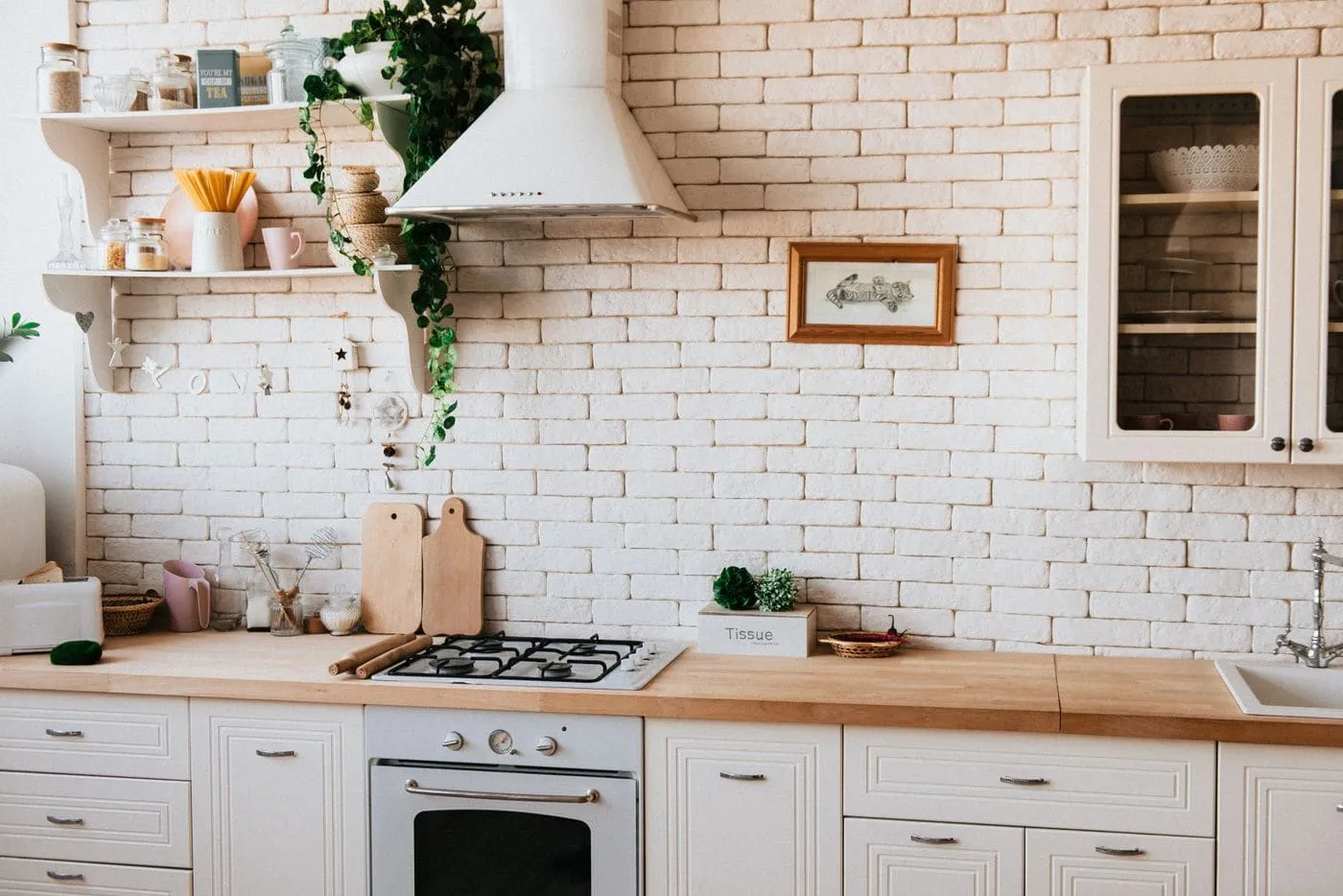
Open shelving or visible worktop storage only looks good when the containers match. A row of mismatched pasta packets, cereal boxes, and half-empty bags reads as clutter no matter how stylish the shelf behind them is. Decanting dry goods — pasta, rice, oats, lentils, coffee, tea — into a matching set of glass jars solves this immediately, and lets you see what you have at a glance, which reduces waste.
Dunelm’s Klip glass jar range starts at ~£8 for four 0.5-litre jars — enough for a basic starter set. For a larger kitchen, IKEA’s Korken range provides eight jars for ~£12. Label them with chalk labels (included with many sets, or ~£3 separately) for a finished look.
5. Use a Wooden Chopping Board as a Worktop Display
A large wooden chopping board leaned against the splashback or laid flat on the worktop as a “station” anchors the kitchen’s cooking area and makes it look immediately more styled. The board grounds any objects placed alongside it — a bottle of olive oil, a small jar of salt, a lemon — into a deliberate composition rather than scattered items.
Oak and acacia boards photograph and look best. A good-sized one (at least 35x25cm) from John Lewis runs ~£18–£30, or Dunelm stocks acacia options from ~£10. The board doesn’t even need to be actively used in cooking — it works purely as a styling anchor. Though in practice, having a beautiful board on the worktop means you actually use it more.
6. Should You Replace Cabinet Hardware With Ceramic or Brass Handles?
Cabinet hardware is the jewellery of a kitchen. Replacing the standard chrome or plastic handles that come with most UK fitted kitchens — or the existing ones in a rented or older property — is one of the most cost-effective ways to change the entire character of the room. New handles don’t require any specialist tools: a screwdriver and 30 minutes is usually sufficient.
Ceramic handles in white or sage suit period and cottage-style kitchens. Brushed brass suits modern and Shaker-style kitchens. Matte black suits industrial and contemporary spaces. Dunelm’s hardware range includes ceramic cup handles from ~£2.50 each. For a typical 10-cabinet kitchen, expect to spend ~£25–£50 total — a fraction of the cost of re-painting or replacing the cabinets themselves.
Note for renters: keep the original handles in a bag and reinstall them before moving out.
7. How Do You Style Open Shelves With the Rule of Thirds?
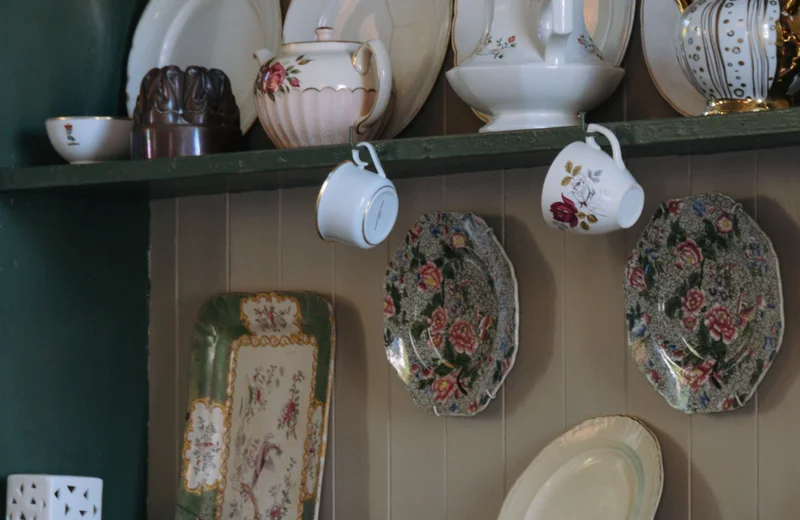
Open shelving is one of the most debated elements in British kitchen design. Done well, it’s warm and personal. Done badly, it looks cluttered and dusty. The difference is almost entirely in the editing — a lot of homes try it and abandon it within a couple of years because keeping a styled shelf tidy takes upkeep.
The rule of thirds makes this manageable: divide each shelf into three visual zones. One zone for purely functional items (stacked white plates, folded tea towels). One for something with height (a ceramic jug, a tall bottle). One left partially empty. This structure gives the eye somewhere to rest and makes the shelf look curated rather than crammed. Use a consistent colour palette — usually white or cream ceramics with one accent colour — and resist the urge to fill every centimetre. Keep 30% of open shelf space deliberately empty — it makes everything else look more considered.
8. Add a Small Countertop Plant (Not Just Herbs)
Beyond the herb display on the windowsill, a single non-edible plant on the kitchen counter or shelf adds life and softness to what is typically a very hard, shiny environment. The kitchen’s conditions — fluctuating temperature, steam, limited natural light if the window is small — rule out many species. But a few do exceptionally well.
Pothos (devil’s ivy) thrives in kitchen conditions, trails attractively over shelf edges, and tolerates inconsistent watering. A small pothos from a garden centre or IKEA costs ~£4–£8. Spider plants and aloe vera are equally tolerant. Place in a ceramic pot that matches your textile colour palette — this ties the plant into the room’s scheme rather than making it feel like an afterthought.
9. Why Mount a Small Magnetic Knife Strip?
A magnetic knife strip does two things simultaneously: it frees up the drawer space that a knife block occupies and it makes the kitchen look more purposeful. A row of knives mounted on the wall reads as “someone who actually cooks lives here” — which is the specific atmosphere a kitchen should have.
IKEA’s Kungsfors magnetic knife rack costs £6 and comes in stainless steel that suits most kitchen finishes. It requires two small wall fixings, which is standard for most tenancy agreements (and fills with a tiny dab of Polyfilla on exit). For renters who want to avoid drilling: a countertop magnetic block from Amazon UK starts at ~£15 and needs no fixings.
10. Should You Use a Ceramic Utensil Crock on the Worktop?
A ceramic utensil crock — a pot holding wooden spoons, spatulas, and tongs — is the functional kitchen equivalent of a bouquet on a coffee table. It takes items that would otherwise be in a drawer and puts them on display in a way that’s both practical and visually warm. The ceramic material makes it look considered; the utensils themselves signal that the kitchen is actually used.
Choose a crock that’s tall enough to hold utensils without them flopping over the rim. Dunelm’s stoneware crock in sage green or off-white (~£8–£12) is the most popular British option. Pair it with wooden utensils rather than plastic or metal for the warmest visual effect. Place it beside the hob — its natural home — rather than pushed to the back of the worktop.
11. Hang a Simple Artwork or Print Near the Dining Area
Kitchens that flow into dining areas or have a visible wall beyond the cooking zone benefit enormously from one well-chosen piece of art or print. The wall at the end of a galley kitchen, the space above the breakfast bar, or the blank wall beside the door — these spots feel wasted without something on them. One print is usually more effective than a gallery arrangement in a kitchen, where the visual environment is already quite busy.
Food-themed art is an obvious choice but can feel predictable. A simple botanical print, an abstract in your accent colour, or a typography piece (“but first, coffee” is, admittedly, done to death) can all work well. The Rijksmuseum’s online collection offers thousands of free high-resolution downloads suitable for printing. An A3 print at Boots Photo costs ~£1.49; an IKEA Ribba A3 frame is £5 — a single framed print for around £6.50 total.
12. Why Match Your Small Appliance Colours?
This is the least often mentioned kitchen styling idea and one of the most effective. The typical British kitchen worktop hosts a kettle, a toaster, and often a coffee machine or air fryer — all frequently in different colours, finishes, and eras. Mismatched appliances create a restless, unresolved look that no amount of decor can overcome.
Replacing even two of the three main appliances in a matching colourway makes a substantial difference. Cream or off-white appliances suit classic and country kitchens. Black suits contemporary spaces. Sage green, cobalt blue, red, and a softer vintage pink have all had strong moments in British kitchen trends. Dunelm’s own-brand appliance range and Russell Hobbs both offer matching kettle-and-toaster sets from ~£45 combined. That’s a single purchase that changes the entire visual register of the worktop.
Priority Order — Where to Start
| Step | What to do | Approx cost |
|---|---|---|
| 1 | Under-cabinet LED strip lighting (2700K) | ~£18–£36 |
| 2 | Coordinated tea towels and oven glove set | ~£8–£15 |
| 3 | Windowsill herb display (3 ceramic pots) | ~£12–£18 |
| 4 | Glass storage jars for dry goods | ~£8–£12 |
| 5 | Large wooden chopping board for worktop | ~£10–£30 |
| 6 | Replace cabinet handles | ~£25–£50 |
| 7 | Style open shelving (editing existing items) | Free |
| 8 | Ceramic utensil crock | ~£8–£12 |
| 9 | Small countertop plant in ceramic pot | ~£5–£10 |
| 10 | Magnetic knife strip | ~£6–£15 |
| 11 | One framed print near dining area | ~£6–£10 |
| 12 | Matching small appliance set | ~£45–£80 |
| Total (all 12) | ~£151–£288 |
Note: Steps 1–4 together cost under £75 and deliver the majority of the visible difference. Start there.
→ For budget-specific kitchen ideas see Kitchen on a Budget UK. → For a full home interior guide see Home Interior Ideas UK. → Tackling one surface at a time? Budget kitchen cabinet makeover ideas, budget kitchen worktop makeover ideas, budget kitchen splashback & tile ideas, and budget kitchen flooring ideas each go deep on a single element.
Frequently Asked Questions
Add a matching set of storage jars, a small herb display, a coordinated tea towel set, and under-cabinet lighting. These four additions cost under £60 combined and make an ordinary kitchen feel genuinely styled.
Shaker-style kitchens remain the most popular in the UK, typically in white, sage green, or navy. They suit both period and modern homes and work across all budgets from IKEA to bespoke.
Light sage green, soft white, and pale grey are the most versatile choices for small British kitchens. They make the space feel larger in the UK's typically grey light without reading cold.
Group items in threes, mix functional and decorative pieces, keep a consistent colour palette (usually white ceramics + one accent colour), and leave 30% of the shelf space empty. Avoid overcrowding — edited shelves always look more intentional.