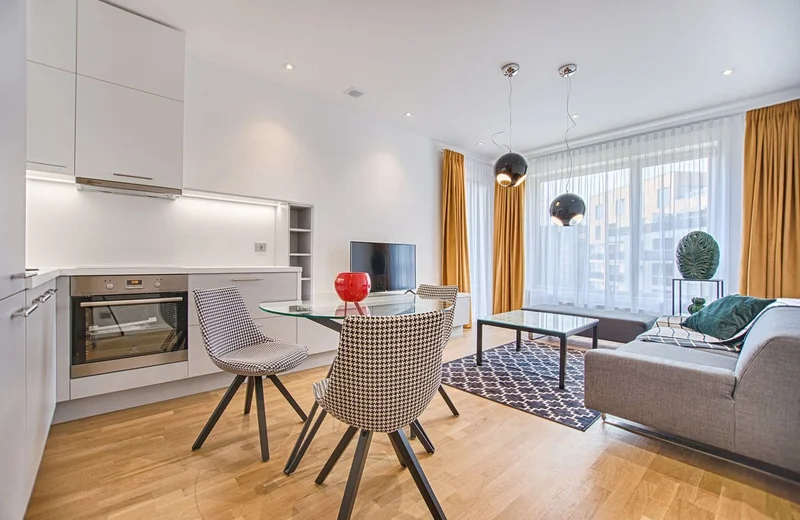
The average new-build living room in the UK measures around 17 square metres — and many older flats, particularly in London and other major cities, are significantly smaller than that. According to the Office for National Statistics (ONS) 2023 Housing Survey, UK homes are among the smallest in Western Europe, with the average floor area 30% below the European average.
This guide covers visual tricks — colour, curtains, mirrors, rug size — and they matter most in a very small living room, the kind you find in a one-bed flat or a 1930s semi. For general living room styling with no space constraint, see How to Style a Living Room UK; for furniture arrangement and floor plans specifically, see Small Living Room Layout Ideas.
We’re working with less space than almost any other European country. And most advice about “making rooms feel bigger” was written for spaces that are already considerably larger than most British flats.
I live in a 15-square-metre living room in a 1930s semi. Here’s what actually works.
TL;DR: The most impactful small-room tricks are ceiling-height curtains, furniture with visible legs, correctly sized rugs, a large mirror opposite the window, and a light-neutral wall colour. Together these can make a small British living room feel genuinely spacious — not just less cramped.
Read more: living room styling guide
1. How Do You Hang Curtains to Make a Small Room Feel Taller?
No single change does more for the perceived height of a small room than curtains hung near the ceiling rather than the window frame. The eye follows the fabric from floor to ceiling and reads the room as taller. The window also appears much larger, and more light enters.
A repositioned curtain pole costs as little as £8 for a new IKEA RÄCKA pole, or nothing if you already own a drill — a small, renter-friendly change that measurably increases how tall a small room reads.
The curtains should be wide, too — extending 15–20cm past the window frame on each side so that when fully open, they sit almost entirely off the glass. This reveals the full window and maximises the natural light that a small room depends on.
If your current curtain pole is mounted at window height, moving it up may simply require repositioning the existing brackets — a 30-minute job with a drill. If you’re in a rented property, check your tenancy agreement before drilling new holes.
Curtain pole repositioned near ceiling — free if you have a drill, or ~£8 for a new IKEA RÄCKA pole.
2. Why Does Furniture With Visible Legs Make a Room Feel Bigger?
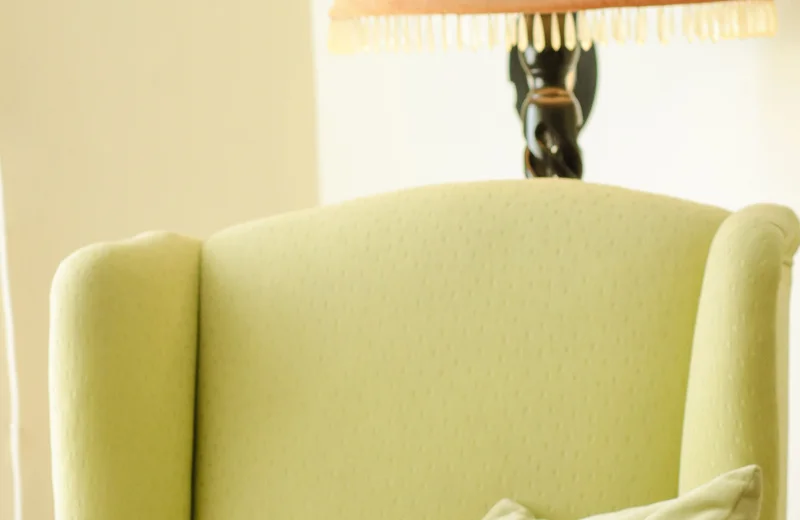
Skirted sofas and chairs — those with fabric or material going down to the floor — visually block the floor and make a room read as heavier and more cramped. Sofas and chairs raised on legs, even short ones, reveal floor beneath them. Your eye sees more floor and the brain registers more space.
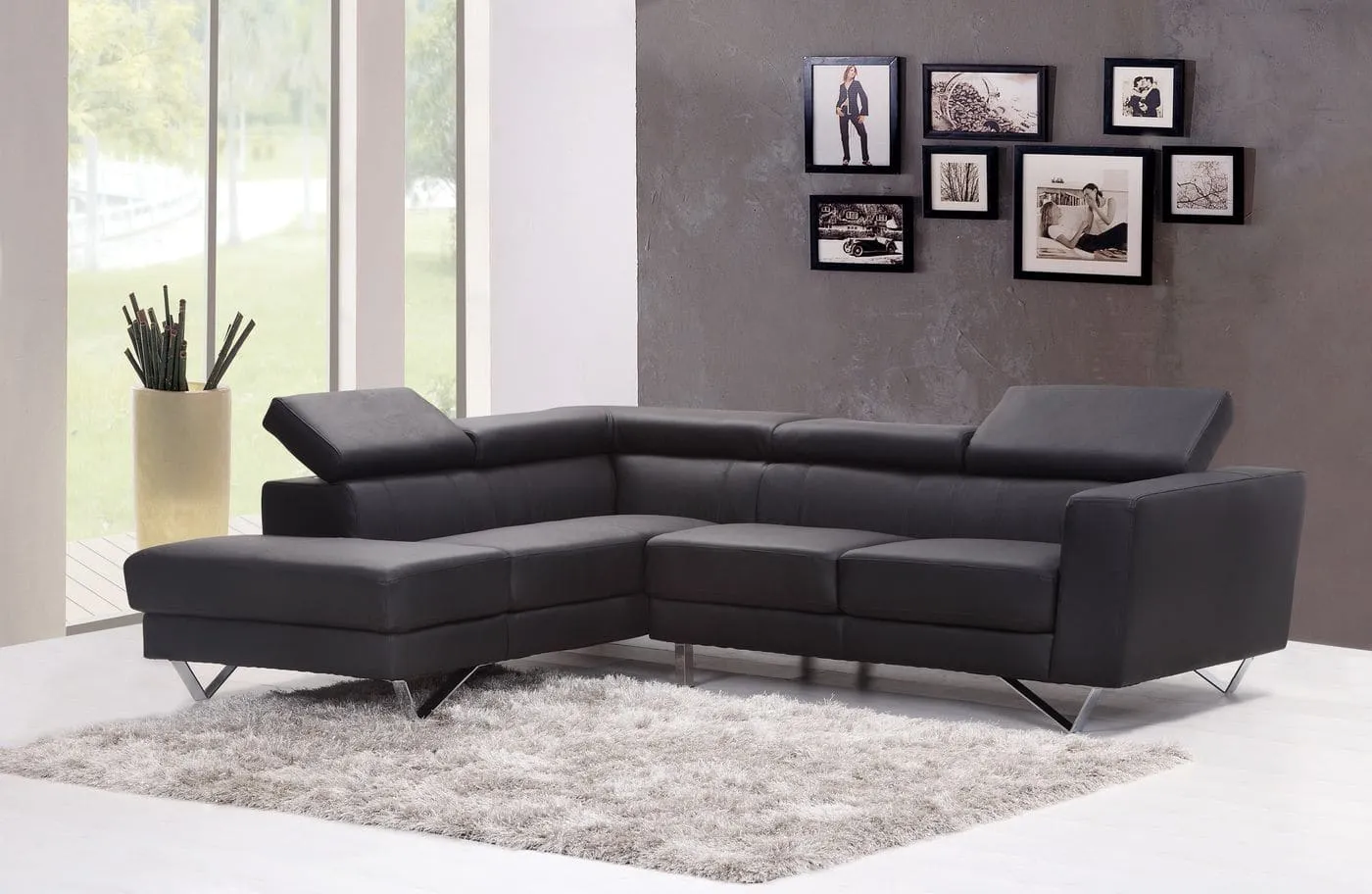
Swapping a skirted sofa for a raised-leg model — such as the IKEA Söderhamn at roughly £499 — reveals visible floor beneath the seating and makes a small room read as noticeably more open, without changing its actual footprint.
This applies to coffee tables and side tables too. A glass or acrylic coffee table top on slim metal legs shows the maximum floor area. A solid wooden cube does the opposite.
I replaced my skirted three-seater with a raised-leg sofa (IKEA Söderhamn, ~£499) and the room felt measurably more open before I changed anything else. The sofa is only slightly smaller in footprint but the visible floor beneath it transformed the room.
Sofa with visible legs — IKEA Söderhamn from ~£499 at IKEA.
3. Where Should You Place a Mirror in a Small Living Room?
In a small room, a large mirror does two things: it bounces natural light deeper into the space, and it creates the visual impression of a second room beyond the wall. Both effects make the room feel significantly larger.
The mirror should be statement-sized — at least 60–80cm wide — to have real impact. Position it opposite or at a 45-degree angle to the main window. Leaning it against the wall rather than hanging it creates a more casual look and avoids renter complications.
Round mirrors are particularly good in small rooms because they avoid competing with the room’s angular architecture. Dunelm’s mirror range starts at ~£25 and includes excellent large-format options.
Large round mirror — from ~£25 at Dunelm.
4. What’s the Right Rug Size for a Small Living Room?
The instinct in a small room is to use a small rug. This is almost always wrong. A rug that’s too small for the furniture arrangement makes the room feel more chaotic, not more spacious — the furniture floats without anchor and the space reads as undefined.
Sizing up from a 90x120cm rug to a 160x230cm one, available from around £45 at Dunelm, is what actually grounds a small room’s furniture arrangement rather than fragmenting it.
The correct minimum in even a small UK living room: at least the front legs of all seating should sit on the rug. This grounds the arrangement and tells the eye “this is the room.” A 160x230cm rug in a small space reads as intentional and considered; a 90x120cm rug floating in the middle reads as an afterthought.
The correctly sized rug paradox: in a small room, the correctly sized rug makes the room feel bigger than a smaller rug, because it defines the space rather than fragmenting it visually.
Correctly sized rug 160x230cm — from ~£45 at Dunelm.
5. Use Warm Neutral Paint — Not Stark White
Many people assume white is the best colour for a small room. In UK conditions, this is often wrong — particularly in north-facing rooms, where natural light is limited and cool throughout the day. Stark white in low UK light reads as grey, flat, and slightly cold.
Warm neutrals like Dulux Goose Down, at around £22 for 2.5L from B&Q, avoid the flat, cold cast that stark white takes on in low, north-facing UK light.
Warm neutrals — Dulux Goose Down, Crown Fossil, Farrow & Ball Pavilion Grey (which despite its name reads very warm) — work better. They add warmth, they read as brighter than they are because warm tones respond well to lamplight in the evening, and they don’t draw attention to the room’s limited size the way that a very particular or saturated colour might.
Warm neutral paint — Dulux Goose Down ~£22 per 2.5L from B&Q.
6. Why Use Floating Shelves Instead of Floor Units?
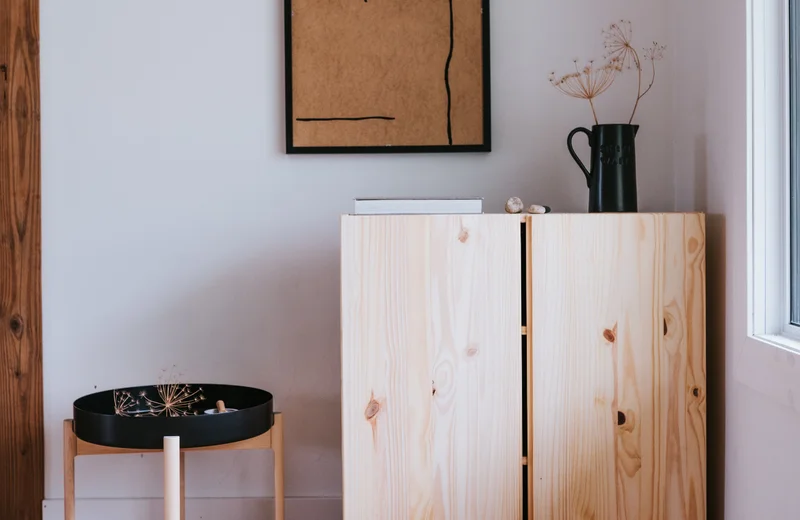
Bookshelves and storage units that sit on the floor add to the visual mass of a small room. Floating shelves mounted on the wall preserve floor area and draw the eye upward, making the ceiling feel higher.
Floating shelves start at around £8 per shelf for IKEA’s LACK range, with wider B&Q options from £15, giving a small room storage and visual interest without occupying any floor space.
In a small living room, a grid of floating shelves on one wall — styled with books, plants, and objects — creates significant storage and visual interest without occupying any floor space at all. IKEA’s LACK shelves are the most reliable budget option at ~£8 per shelf. B&Q has wider and deeper floating shelf options from ~£15.
Renters: floating shelves require wall fixings. Check your tenancy agreement — some landlords permit shelving with written approval, especially if you agree to fill the holes on exit.
Floating shelf — IKEA LACK from ~£8 at IKEA.
7. What Size Sofa Works Best in a Small Living Room?
In a small living room, sofa scale matters more than almost any other furniture decision. A large three-seater or sectional sofa in a small room dominates the space and leaves little room to move. A two-seater or compact three-seater at the right depth (typically under 90cm deep from front to back) allows the room to breathe.
A compact sofa under 90cm deep, such as options from Next Home starting around £299, lets a small living room breathe in a way a standard-depth three-seater can’t.
Standard UK sofas are often too deep for small living rooms. Look for sofas described as “apartment” or “compact” sizes — Dunelm and Next Home both label these clearly. Pair with a single armchair for flexibility without bulk.
Compact two-seater sofa — from ~£299 at Next Home.
8. Use Nesting Tables Instead of a Coffee Table
A fixed coffee table in a small living room takes up floor space permanently. Nesting tables — typically a set of two or three tables that stack together — take up the footprint of one small table when nested and spread out to serve multiple purposes when needed.
A set of nesting tables from around £35 at Dunelm or Wayfair takes up the footprint of a single small table when stacked, freeing floor space a fixed coffee table would otherwise claim permanently.
They’re particularly useful for small flats where the living room doubles as a dining space, or where you regularly have people over. When nested, the floor area they reveal makes the room feel considerably more open.
Dunelm and Wayfair both stock nesting tables from ~£35 per set.
Set of nesting tables — from ~£35 at Dunelm.
9. What TV Size Is Right for a Small Living Room?
An oversized television in a small living room dominates the space visually and forces furniture to be positioned further back than the room allows. A screen that’s too large for the viewing distance (less than 1.5x the screen diagonal for comfortable watching) also creates eyestrain.
For the typical 2-2.5 metre sofa-to-TV distance in a small UK living room, a 43-50 inch screen is the proportionate choice — anything larger dominates the room without improving the viewing experience.
For a small UK living room with a typical sofa-to-TV distance of 2–2.5 metres, a 43–50 inch screen is the right proportion. Going larger doesn’t improve the experience — it just makes the screen more visually dominant when switched off.
Correct TV size for small rooms: 43–50 inches at 2–2.5m viewing distance.
10. Use a Single Pendant or Picture Light Over the Sofa
Rather than relying on a central ceiling rose (which draws the eye to the middle of the ceiling and makes the room feel boxier), use a pendant hung low over a side table, or a picture light mounted on the wall, to create lighting that exists at a lower level and adds depth rather than overhead glare.
A plug-in pendant light from around £22 at Dunelm creates lower, warmer lighting than a central ceiling rose, without any rewiring — making it renter-friendly too.
Plug-in pendant lights — which don’t require rewiring and work in rented properties — are available from Dunelm from ~£22. These hang from a ceiling hook (which can be adhesive in plaster ceilings) and the cord runs to a wall plug.
Plug-in pendant light — from ~£22 at Dunelm.
11. Edit Aggressively
In a small living room, every item either earns its place or makes the room feel smaller. Editing — removing objects that don’t actively serve the space — is the final and often most powerful technique.
In my own small living room, removing just seven objects from surfaces and shelves — at zero cost — made the space feel measurably more open. No new purchases were involved; editing is often more effective than any purchase.
The test: does this object make the room better to be in, or does it just exist? Scatter cushions beyond four, decorative objects beyond the rule-of-three groupings, side tables without clear purpose, and floor items that could be shelved — all of these should be considered for removal.
Cost: nothing. Set aside an hour to edit without adding anything.
Priority Order
| Step | What to do | Approx cost |
|---|---|---|
| 1 | Raise curtain pole to ceiling height | Free–£8 |
| 2 | Add large mirror opposite window | ~£25–£45 |
| 3 | Edit surfaces and shelves aggressively | Free |
| 4 | Replace coffee table with nesting tables | ~£35–£60 |
| 5 | Check rug size — upgrade if too small | ~£45–£80 |
| 6 | Apply warm neutral paint | ~£22–£35 |
| 7 | Add floating shelves to replace floor units | ~£8–£25 |
→ For more living room styling advice see How to Style a Living Room UK. → For budget-specific ideas see Living Room on a Budget UK. → Want a softer, romantic look instead? Cottagecore home decor ideas covers that style direction. → Prefer bold and layered over minimal? Maximalist living room decor is the opposite approach, done properly. → Ready for the kitchen? Kitchen on a Budget UK is the most-read guide on the site.
Frequently Asked Questions
The most effective techniques: hang curtains close to the ceiling, use furniture with visible legs, place a large mirror opposite the window, choose a correctly sized rug (not too small), and keep colours light and warm rather than dark and heavy. For furniture arrangement in a tight room, see [Small Living Room Layout Ideas](/blog/small-living-room-layout-ideas/).
In a small UK living room, a rug that's too small makes the space feel more cramped, not less. The minimum for a small living room is typically 120x170cm. If possible, go 160x230cm — the correct sizing reads as intentional and grounds the seating area properly.
Furniture raised on legs (sofas, chairs, coffee tables) shows floor and makes rooms read as larger. Nesting tables over a fixed coffee table. A two-seater or compact three-seater sofa rather than a large sectional. Floating shelves over floor-standing units to preserve floor area.
Warm neutrals and soft whites work best in small rooms — Dulux Goose Down, Crown Fossil, or Farrow & Ball Pavilion Grey. Dark colours can work in small rooms if the lighting is excellent, but they're less forgiving. Avoid cool greys in north-facing UK rooms as they read flat and cold.
In a very small living room (under 12 square metres), the priority order changes: get the sofa off the wall it shares with the door, use a two-seater or a corner sofa rather than a three-seater, hang curtains at ceiling height and let them cover the wall either side of the window, and add one large mirror opposite the light source. Skip the coffee table for nesting tables or a small round side table. One larger piece of furniture always reads better than several small ones fighting for the floor.